














An Analogy of the Phases of Biblical Discipling and Counseling
Imagine at the beginning, a boat being created and christened to sail the seven seas to do the will of its owner. For a short time all was well, but then a stowaway triggered a mutiny. When the two crew members rebelled, the ensuing conflict caused an explosion and the ship sank to the bottom of the sea. Many generations later the owner’s family sent a salvage operation to raise, restore, and re-commission this vessel. The owner’s only son was able to raise that ship and repair it, but lost his life in the process. When the ship was re-commissioned, there were high hopes that it would fulfill its destiny and potential by sailing the seven seas and doing the will of its owner’s family.
The new crew was elated and very thankful for the opportunity to see the ship restored to its original capacity of floating on the surface, freed from the ocean depths. They received their voyage instructions for the mission and launched out. Seeing some oars on the boat, they each grabbed one and settled down to row the boat to their first destination. They tried their best to follow the map, navigation and plan of the owner. But as they rowed hour after hour, the crew realized that they weren’t making much progress in the big scheme of things. As a matter of fact, they got more and more weary in spite of the gratitude they had for this opportunity to be aboard such a fine ship. They got more and more fatigued and discouraged until they finally radioed to the owner saying “If this is what it takes to be on this crew, then we would rather find some other job.”
Then the owner gave them instructions to look again toward the front of the boat. When they did so, they gazed at the mast of the ship. Its vertical beam held the horizontal pole forming the silhouette of a cross against the deep blue and white horizon. The owner radioed what they should have known all along. There were large pieces of fabric tucked away up front—sails! So they unpacked the sails and hoisted them up the mast. As the wind caught the sails, they billowed out as the ship moved ahead under a new source of power!
As they believed the owner’s instructions and hoisted those sails, they had a whole new optimism of their potential to go to the Ports of Call and do the owner’s business. The crew was relieved and encouraged. Their whole perception of the vessel changed when they laid aside the oars and managed the ship’s sails and rudder instead. The ship’s real identity became obvious: she was a sailboat, not just a cumbersome row boat!
But, alas, it wasn’t long after that that they realized that in spite of their new potential, in spite of not being as fatigued, they still were not making the forward progress that they expected. So after some time fighting against the current they grew disillusioned again. Once more the crew did what they should have been doing all along—they radioed the owner and got additional counsel. He instructed them to carefully examine the back rim of the vessel; where any ropes over the side? When they pulled back some old nets, they discovered a chain that ran over the side and into the water. Could it be? Yes … they pulled up the long chain and found a small barnacle-encrusted anchor. How foolish; they had been, dragging dead weight all this time!
It became obvious that, even with full sails, the crew would not make much progress when so encumbered. With humility and relief they stowed the anchor and experienced a new freedom. Full speed ahead! Now, not only did the wind fill the sails, but without the resistance of that chain and anchor, their speed was up to the ship’s potential.
The crew were quite overjoyed with their new freedom, along with their full sails. For the remainder of the voyage, their tasks were to study the maps, to stay in touch with the owner by radio, tend the sails, and navigate. At each Port of Call they would have the opportunity to participate in the owner’s royal business.
Part II The symbolism of the Parable
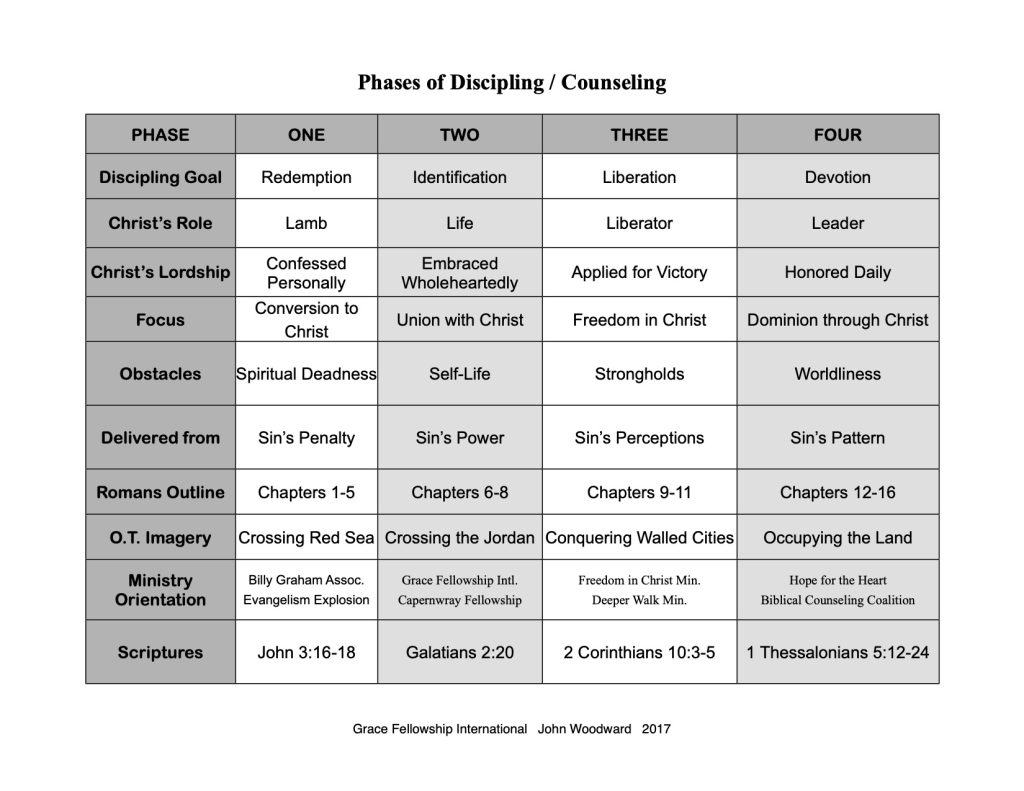
Phase 1: Redemption
We were originally created by God to be vessels of His life. But due to Adam and Eve’s original sin (like the mutiny), there was a loss of life. That caused our first parents, and their descendants, to miss out on the life of God (Rom. 5:12). Just like that ship that sunk to the bottom of the sea and lost it functionality as a ship, so we have lost our spiritual potential as those as vessels of God’s life and Spirit (Eph. 2:1). Everyone needs to experience God’s regeneration, the ultimate salvage operation (John 3:3).
God’s love motivated Him to send His Son on the mission of finding and restoring the lost vessel (John 3:16-18). Although He succeeded in this mission, it cost Him His life; He gave Himself as a sacrifice on the Cross (1 Pet. 3:18). When we receive Jesus Christ as Lord and Savior, we are restored to be vessels of God’s life. We have been restored to spiritual life, drawn up from the depths of darkness of sin and condemnation. Believers are restored to life with God and their spirit is made alive (Titus 3:5-7). Similarly, the ship was restored to float again, to function as a ship.
Phase 2: Identification
But just like that crew that got out the oars and rowed with determination, sincerity and gratitude, so in the Christian life, the typical pattern is that we try to live our Christian life for the Lord. Even with an attitude of devotion, we assume that we have to live the Christian life based upon our strength, our determination, and our service for Him. So, typically, we come to a point in our life where we become fatigued, discouraged, and worn out. We feel like Paul who said “Oh wretched man that I am, Who will deliver me from this body of death?” (Rom. 7:24).
In the Parable, the crew was instructed to look ahead. When they did, they saw the mast which was in the shape of a cross. Likewise, God’s Word calls to look again to the Cross, this time to realize more fully that not only did Christ die for us, but we died with Him. When we recognize this identification truth, God invites us to reckon our death, burial, resurrection, and ascension with Christ as personally true (Rom. 6:3-11). Knowing that we have been raised and ascended with Christ (Eph. 2:4-7) is like “hoisting the sail.” When that is an experiential reality, the Holy Spirit empowers our lives and shows us that we are no longer living by ourselves, but Christ is living in and through us (Eph. 5:18; Gal. 2:20).
The crew realized that they weren’t really in a row boat, but were really a sailboat. Likewise, our identity has changed. We are not just sinners, but we are saints, children of God, and a royal priesthood! (2 Cor. 5:17; Eph. 1:2; 1 John 3:1-3; 1 Peter 2:9).
Phase 3: Liberation
In the parable, the crew had to discover the chain trailing off the stern of the boat. They then hoisted the anchor and put it out of the way. Likewise, the Lord says, “You shall know the truth and the truth will set you free.” We need not be hindered by false beliefs and unresolved conflicts. In Christ we are authorized to get rid of the weights of sinful habits and deception that hinder us (Heb. 12:1,2). We have spiritual weapons that are more than adequate to tear down strongholds (2 Cor. 10:3-5). So, God calls us to appropriate our freedom in Christ and replace every false belief with truth. Then, instead of being held back and hindered by these strongholds, we can experience the freedom of God’s truth. With this freedom, the power of the Holy Spirit is even more evident in our lives to accomplish God’s purposes.
Phase 4: Devotion
That leads us to the fourth part of our journey which is ongoing devoted discipleship. In the parable, the crew moved on in their voyage with new power and their new freedom. They then focused on the map (God’s Word) and went to their Ports of Call (ministry). Similarly, in practical discipleship we need to read God’s Word, continuing to learn of His wisdom and ways. We are to walk in fellowship with Him and let Him guide our path (Prov. 3:5,6). As He lives His life in and through us, we have the privilege to cooperate in fulfilling God’s will.
This parable illustrates Spirituotherapy 2.0: “The Four Phases of Discipleship Counseling”
Dr. John Woodward
Grace Fellowship International
2006